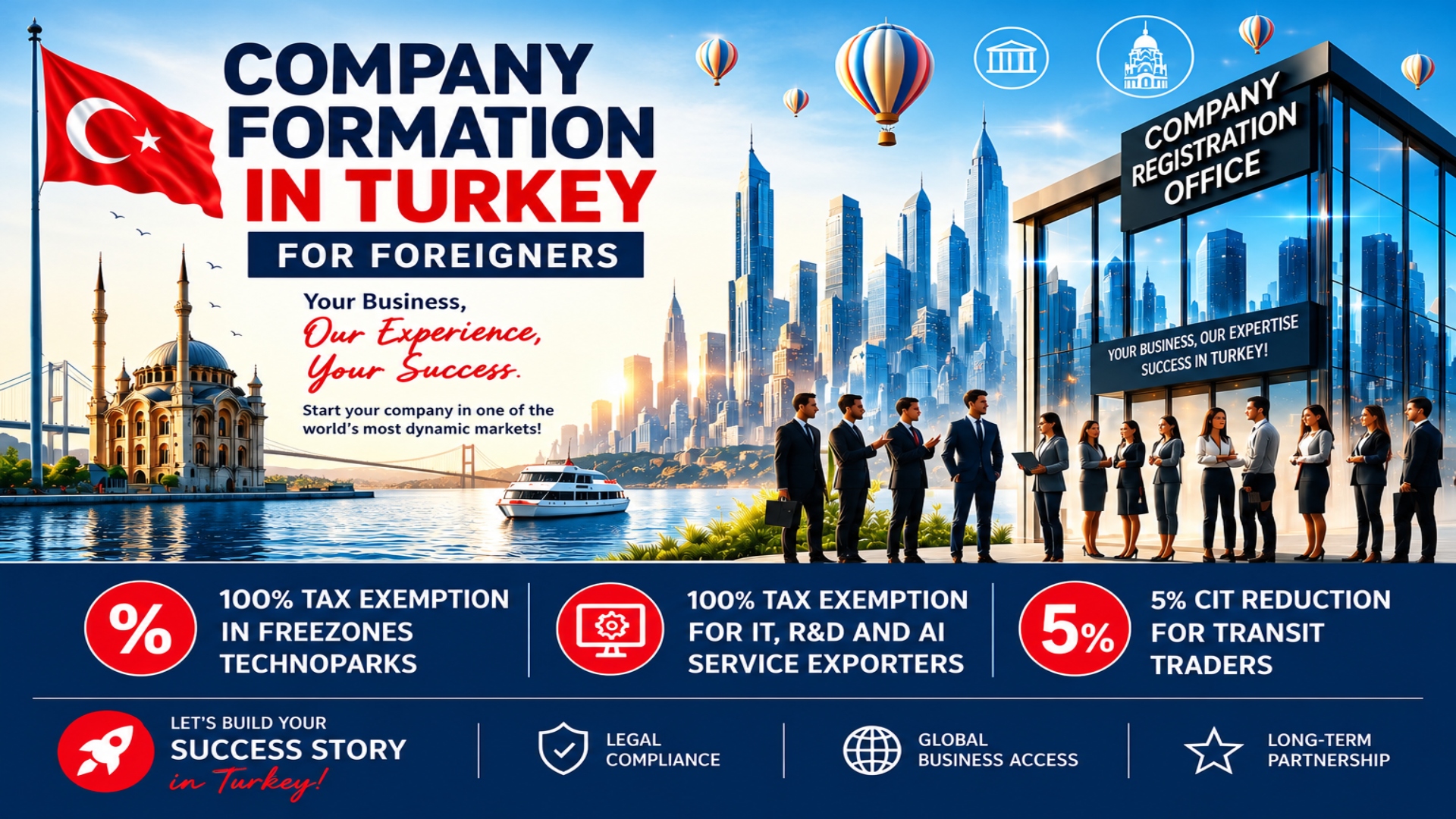

Turkey has long been an important commercial bridge between Europe, Asia and the Middle East. For European companies looking to expand beyond their domestic markets, the country can provide access to a large domestic economy, established manufacturing capabilities, international trade routes and a strategically positioned business environment.
However, expanding into Turkey requires more than identifying a market opportunity. Companies also need to consider the appropriate legal structure, taxation, accounting, employment, banking and ongoing compliance requirements before beginning operations.
For European businesses considering Turkey as their next international market, understanding these practical issues at an early stage can make the expansion process more structured and predictable.
Why Are European Companies Expanding into Turkey?
Turkey’s geographical position makes it relevant to companies with operations across Europe, the Middle East and surrounding markets.
European businesses may consider Turkey for different reasons, including:
- Establishing a local sales operation
- Manufacturing and production
- Import and export activities
- E-commerce
- Technology and software services
- Regional headquarters
- Logistics and distribution
- Professional and business services
The appropriate approach depends heavily on the company’s business model.
A company that only sells products to Turkish customers may have different requirements from a business establishing employees, warehouses, manufacturing facilities or a fully operational subsidiary.
For this reason, market-entry planning should begin with a clear understanding of what the company actually intends to do in Turkey.
Establishing a Legal Presence in Turkey
One of the first decisions for a European company is whether it needs a Turkish legal entity.
Depending on the business model, companies may consider a subsidiary, branch or, in limited circumstances, a liaison office.
A Turkish subsidiary can provide a separate legal structure through which the foreign parent company conducts local business activities.
The most common corporate structures include the Limited Liability Company and Joint Stock Company.
The appropriate structure depends on factors such as:
- Number of shareholders
- Investment size
- Planned activities
- Financing requirements
- Future expansion
- Management structure
- Employment plans
European companies planning to establish a local entity can review this guide to Company Registration in Turkey for an overview of the registration process and the main requirements for foreign investors.
Choosing Between a Subsidiary and a Branch
A foreign company does not necessarily have to establish a Turkish subsidiary in every situation.
A branch can be considered when the parent company wants to conduct business in Turkey as an extension of the foreign entity.
A subsidiary, on the other hand, is a separate Turkish legal entity and may provide a more appropriate structure for companies planning long-term commercial operations.
The decision should be based on the intended activities rather than simply on the perceived simplicity of one structure.
Companies should consider the legal, tax, accounting and operational consequences of each option before making the decision.
Taxation for European Companies Operating in Turkey
Tax is an important consideration when expanding into a new jurisdiction.
A Turkish company can be subject to several different taxes depending on its activities and transactions.
These may include:
- Corporate income tax
- Value Added Tax (VAT)
- Withholding tax
- Payroll-related taxes
- Social security contributions
- Customs duties
- Other transaction-specific taxes
The company’s tax position will depend on the nature of its business and the transactions it carries out.
European parent companies should also consider the interaction between Turkish domestic tax rules and international tax arrangements, particularly where transactions take place between related companies in different jurisdictions.
Tax Incentives for Foreign Investors
Turkey has a range of investment incentive mechanisms that can be relevant to qualifying investments and activities.
Depending on the investment and the applicable conditions, incentives may include VAT and customs duty exemptions, corporate tax reductions and other forms of investment support.
Certain sectors and business models may also qualify for specialized regimes.
For example, companies involved in technology and R&D may need to examine Technopark-related incentives, while manufacturing and export-oriented businesses may consider investment incentive or Free Zone opportunities.
European companies planning a significant investment should therefore examine Tax Incentives in Turkey as part of their initial investment planning.
It is important to note that tax incentives are not automatically available to every foreign-owned company. Eligibility depends on the relevant legislation, the investment characteristics and the conditions applicable to the specific incentive.
VAT and Import Considerations
Companies importing goods, machinery or equipment into Turkey should consider VAT and customs treatment before beginning operations.
The tax treatment of imports can affect the company’s working capital requirements and the overall cost of establishing local operations.
VAT also becomes relevant to domestic transactions involving the sale of goods and services.
For businesses with significant transaction volumes, establishing appropriate invoicing and accounting systems from the beginning can help reduce administrative problems later.
Companies should also determine whether electronic invoicing and electronic accounting systems apply to their activities.
Accounting and Financial Reporting
Once a Turkish entity begins operating, it must comply with applicable accounting and reporting requirements.
This can involve:
- Maintaining statutory accounting records
- Recording commercial transactions
- Preparing tax declarations
- Managing VAT reporting
- Maintaining payroll records
- Issuing compliant invoices
- Managing electronic accounting systems
- Supporting financial and tax documentation
For European companies unfamiliar with Turkish accounting practices, local professional support can be particularly useful.
The accounting system should also be designed around the company’s international structure.
For example, a Turkish subsidiary may purchase goods from its European parent, receive management services from the group or sell products to other group companies.
These transactions may require additional documentation and tax analysis.
Banking and Payments
Opening a corporate bank account is another practical consideration when establishing operations in Turkey.
Banks may request information about:
- Shareholders
- Directors
- Company activities
- Expected transaction volumes
- Source of funds
- Corporate ownership
- Business relationships
Foreign companies should therefore prepare their corporate documentation and ownership information before beginning the banking process.
Companies conducting international transactions should also consider how payments between the Turkish operation and its European parent will be structured and documented.
Hiring Employees in Turkey
Companies establishing a physical presence in Turkey may need to recruit local employees or transfer personnel from abroad.
Employment brings additional obligations concerning:
- Employment contracts
- Payroll
- Income tax
- Social security
- Employee declarations
- Working conditions
- Leave and termination procedures
Foreign employees may also require appropriate work authorization.
These obligations should be considered before hiring begins because payroll and social security compliance are ongoing responsibilities rather than one-time registration procedures.
Managing Ongoing Tax Compliance
Establishing a company is only the first stage of market entry.
After incorporation, businesses need to maintain ongoing compliance with Turkish tax and accounting requirements.
Depending on the company’s activities, this can include regular tax declarations, VAT reporting, payroll filings, electronic accounting requirements and annual corporate tax obligations.
Changes to the company’s activities can also affect its tax position.
For example, a company that initially operates as a local sales subsidiary may later begin exporting services, employing additional personnel or importing machinery.
Its tax and compliance requirements may consequently change.
European companies should therefore periodically review their Turkish operations rather than treating compliance as a one-time incorporation issue.
Structuring Cross-Border Transactions
European companies operating through Turkish subsidiaries often have transactions with their foreign parent or other group companies.
These transactions can include:
- Product purchases
- Management fees
- Software licensing
- Consulting services
- Financing
- Royalty payments
- Intercompany loans
The tax treatment of these transactions should be considered carefully.
Companies should maintain appropriate agreements and supporting documentation and evaluate the applicable transfer pricing and withholding tax requirements.
The objective should be to establish a structure that is commercially practical while remaining compliant with the tax rules applicable in both jurisdictions.
Choosing the Right Location in Turkey
Location can also influence the structure and cost of an investment.
Companies may consider Istanbul and other major commercial centres depending on their activities.
Manufacturing businesses may focus on industrial zones and locations with access to logistics infrastructure, while technology companies may consider Technology Development Zones.
Export-oriented businesses may also examine Free Zones.
Location should therefore be evaluated alongside the company’s operational requirements rather than solely on office or property costs.
Common Challenges for European Companies
Companies entering Turkey for the first time may encounter several practical challenges.
Understanding Local Administrative Procedures
Processes involving company registration, tax offices, banks and employment authorities can differ from those familiar to European businesses.
Coordinating International and Local Accounting
The Turkish company’s statutory accounting requirements need to work alongside the reporting requirements of the European parent company.
Managing Tax Compliance
Tax deadlines, electronic systems and documentation requirements need to be incorporated into the company’s regular financial processes.
Understanding Local Employment Rules
Employment and payroll procedures should be established before staff are hired.
Planning Before Investing
Some tax incentives and investment benefits have specific eligibility conditions. Considering them only after expenditure has already been incurred may limit the available options.
A Practical Market Entry Checklist
European companies considering Turkey can use the following checklist when preparing their expansion plan:
1. Define the Turkish business model
Determine whether the operation will involve sales, manufacturing, services, logistics, technology or another activity.
2. Select the appropriate legal structure
Evaluate whether a subsidiary, branch or another structure is appropriate.
3. Assess tax implications
Review corporate tax, VAT, withholding tax and international tax considerations.
4. Examine available incentives
Determine whether the investment may qualify for investment, Technopark, Free Zone or other incentive regimes.
5. Prepare accounting infrastructure
Establish bookkeeping, invoicing and reporting procedures.
6. Plan banking arrangements
Prepare the documentation required for corporate banking.
7. Establish employment procedures
If employees will be hired, arrange payroll and social security compliance.
8. Plan ongoing compliance
Ensure that tax, accounting and statutory obligations are managed after incorporation.
Professional Support for European Businesses
Expanding into a new jurisdiction requires coordination between commercial planning, legal structure, taxation and accounting.
For European companies entering Turkey, working with advisers familiar with both the local business environment and the needs of international companies can help simplify this process.
A&M Consulting Co. provides services to foreign companies and international investors establishing and operating businesses in Turkey, including company registration, tax consultancy, accounting, payroll and tax compliance support.
The company’s services can be particularly relevant to European businesses that need assistance coordinating their Turkish operations with an existing international group structure.
Conclusion
Turkey can offer European companies a range of opportunities for market expansion, manufacturing, technology, international trade and regional operations.
However, successful expansion requires more than identifying a commercial opportunity. Companies need to understand the appropriate legal structure, tax regime, accounting requirements, banking procedures, employment obligations and ongoing compliance responsibilities.
Planning these issues before establishing operations can help businesses make more informed decisions and avoid unnecessary administrative complications.
For European companies considering Turkey as their next market, a structured approach to company establishment and tax planning can provide a clearer foundation for long-term operations.
Contact A&M Consulting Co. for professional assistance with establishing and managing a business in Turkey.