




Balancing a vivid cultural mosaic left behind by the Moors, Jews, and Christians, Andalusia’s architecture offers an unmissable charm.
12th February 2024 · 3 min readResidential Lighting Upgrades in Ireland: A Practical Guide for Property Developers and Contractors
Posted on 5th November 2026 · 4 min read
A residential lighting upgrade can look straightforward on paper: replace older fittings, choose a warmer colour of light and reduce electricity use. In practice, the decisions that matter most are often made before anyone orders a single luminaire. Ceiling construction, room use, wiring, controls and maintenance access can all affect whether a new installation works as intended.
For Irish landlords, property managers, developers and homeowners undertaking substantial renovations, lighting deserves the same early attention as flooring, heating or kitchen layouts. The fittings may be small, but the consequences of getting their placement wrong are difficult to hide.
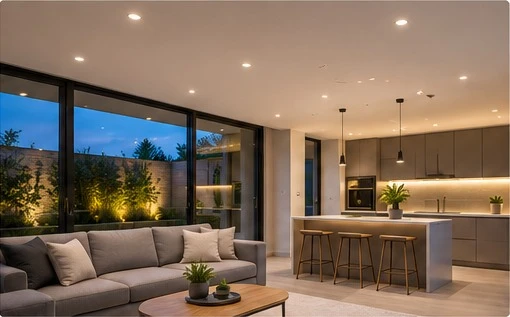
In an open-plan home, separate lighting layers allow the kitchen and living area to serve different purposes.
Start with how each room is actually used
A kitchen needs light on worktops, not simply a bright ceiling. A living room may need a softer general level with a separate lamp or wall fitting for reading. Hallways need clear, comfortable visibility, particularly around stairs and changes in floor level. Bedrooms benefit from controls that can be reached without crossing a dark room.
These distinctions become more important in rental properties, where one lighting scheme has to work for different occupants. A layout built around a single central fitting can be inexpensive to install, yet frustrating to use if furniture or cabinetry casts shadows across the places where people need light.
Choose fittings to suit the space, not the catalogue photograph
There is no universally correct fitting for every residential interior. Recessed downlights work well in many kitchens, circulation spaces and bathrooms when their spacing and beam distribution are planned properly. Surface-mounted ceiling lights can be a better option where recess depth is limited. Wall lights add a separate layer of illumination without occupying floor space, while linear lighting can be useful over work surfaces or beneath cabinets.
For anyone comparing residential led lighting fixtures, it helps to assess the range by application first: where the light will be installed, what it needs to illuminate and how it will be controlled. Irish supplier Ledex Lighting offers residential options across several fitting types, making it possible to compare approaches rather than selecting on appearance alone.
Light output is more useful than wattage alone
Wattage describes electrical consumption; lumens describe the amount of visible light produced by a fitting. Two LED products with similar wattages can produce different amounts of light, and the same fitting can feel very different depending on ceiling height, beam angle and the surfaces around it.
Colour temperature also affects the experience of a room. Warm white light, often around 2700–3000K, is commonly chosen for lounges and bedrooms. A neutral white option around 4000K may suit certain kitchens, utility spaces or work areas. Neither choice is automatically better: consistency within a room, finishes and occupant preferences matter more than following a rigid rule.
Glare is another frequently overlooked detail. A powerful downlight placed directly above a sofa or at the end of a long hallway may be uncomfortable even if the room is technically bright enough. The position and optical design of the fitting deserve attention alongside its output.
Check the building before committing to recessed lighting
Recessed fittings can introduce practical complications in older properties and retrofit projects. Installers need to confirm available ceiling void, insulation arrangements, fire performance requirements where applicable and access to drivers or other replaceable components. In some buildings, a surface-mounted fitting may avoid unnecessary disruption.
Bathrooms and other moisture-prone locations require additional care. The appropriate ingress protection and installation position depend on the bathroom zone and applicable electrical rules; a blanket claim that every bathroom light must have the same IP rating is misleading. A qualified electrician should assess the installation against the relevant Irish requirements.
Controls can make a bigger difference than expected
Not every room needs smart lighting, but most homes benefit from sensible switching. Separate circuits for kitchen worktops and general illumination, dimming in living areas, or a motion sensor in a utility room can improve everyday usability without turning the house into a complicated automation project.
Compatibility should be checked before purchase. Not every LED driver is dimmable, and not every dimmer works reliably with every LED load. For multi-unit developments, consistency of controls and replacement components can also simplify future maintenance.

Wall-mounted bedside lighting gives occupants a useful alternative to switching on the entire room.
Think about maintenance over the life of the property
For an owner-occupier, replacing an awkwardly positioned fitting is an inconvenience. For a landlord or facilities team, the same issue may mean arranging access, scheduling a contractor and sourcing a compatible replacement. Those indirect costs can outweigh small differences in the original purchase price.
Before specifying fittings across multiple rooms or properties, check the warranty, availability of replacement products and whether drivers or other components can be serviced. A consistent range can be easier to maintain than a collection of unrelated fittings chosen one room at a time.
Plan the upgrade as part of the wider renovation
Lighting decisions are best settled while the electrical layout can still be changed. Kitchen cabinets, wardrobes, bathroom mirrors and door swings all influence where a fitting should go. Once plastering and decoration are complete, moving a downlight or adding a switch becomes a much more expensive exercise.
A useful pre-installation review should establish the purpose of each room, the lighting layers required, the desired colour temperature, control locations and any special installation constraints. It should also identify which areas need a closer look from a qualified electrical contractor.
The aim is not to install more lights. It is to put the right amount of light in the right places, with controls that make sense for the people who live there. For Irish residential properties, that is the difference between a quick cosmetic update and a lighting scheme that remains comfortable, practical and maintainable for years.
Popular Articles




Best Bilingual IB School 2026 – Attica
5 min read
Best AI Contract Review Software in 2026: Three Tools and Who Each One Suits
4 min read
Japan or the Republic of Korea? 7 Things European SMEs Should Know Before Expanding into Asia
4 min read
5 Best Enterprise Risk Management Software to Retire the Risk Register Spreadsheet
7 min read
You Might Also Like
A Journey Through Andalusia’s Architectural Gems

Cell Impact is One of the Fastest Growing Tech Companies in Sweden
The need for green technology that can solve the climate crisis has increased sharply. This applies in particular to the demand for hydrogen technology.
23rd February 2023 · 2 min read
A Greener Future for British Cities: What Should You Know About ULEZ?
As our planet endures the damaging effects of climate change, many of us have considered making some eco-friendly amends to our lifestyles.
27th January 2022 · 4 min read