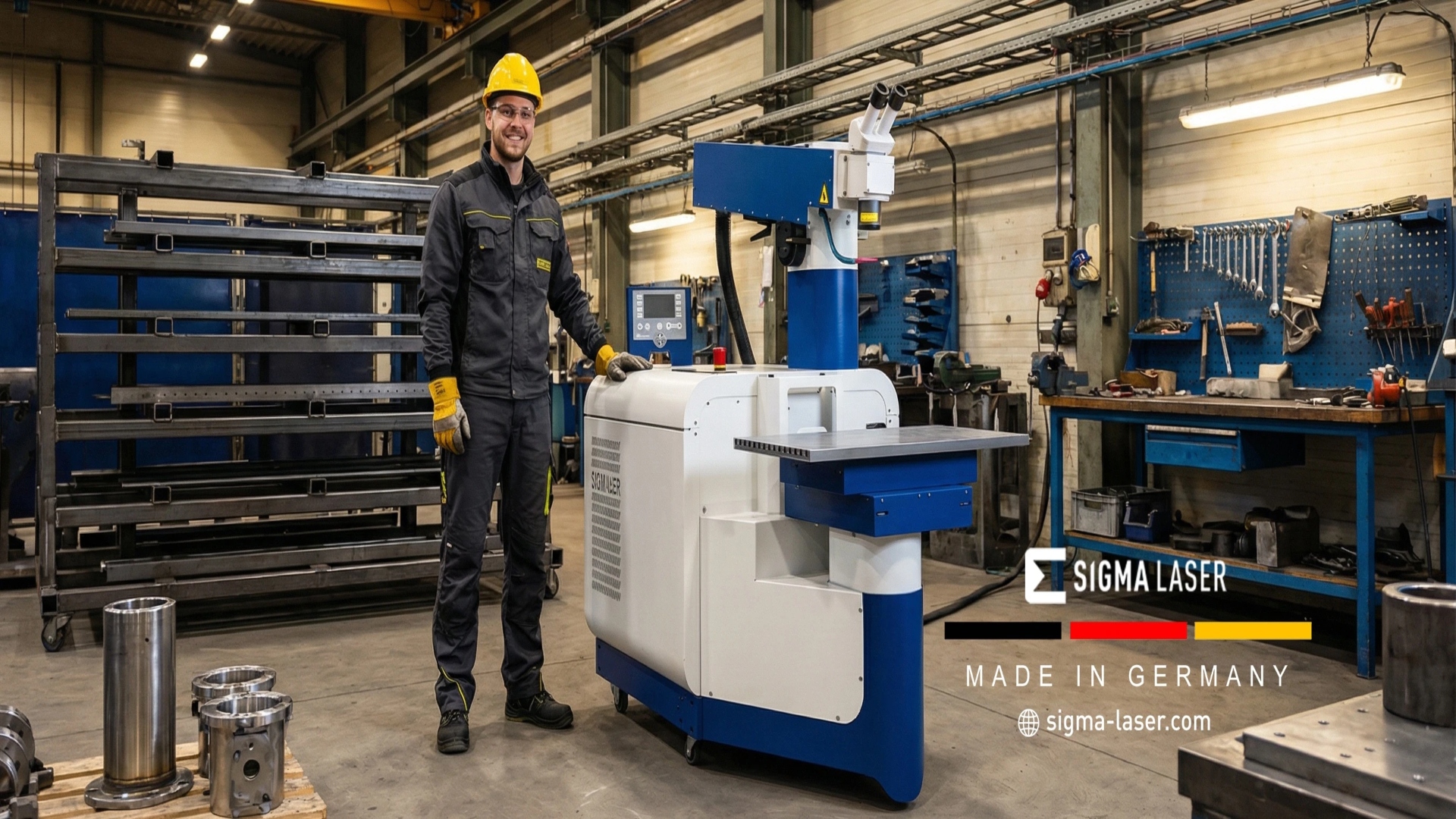

Sigma Laser is a German laser welding machine manufacturer based in Hanau and founded in 2005. Its six mobile and stationary systems use Nd:YAG and fibre laser sources with five-axis positioning, serving tool and mould makers, medical device, aerospace and electronics manufacturers in more than 25 countries.
Company facts
Sigma Laser builds industrial laser welding machines for repair, modification and small-series work. The company designs and manufactures in Hanau. The range comprises six open-frame, 5‑axis systems with no workpiece size or weight limit. Customers include industry and suppliers across Europe and beyond.
| Fact | Detail |
| Founded | 2005 |
| Headquarters | Hanau, Germany |
| Product range | Six 5‑axis open-frame laser welding systems: mobile (Sineo Light, Sineo Fibre, Sirius Light) and stationary (Sidanus Light, Sidanus Fibre, Siega Fibre); no workpiece size or weight limit |
| Beam sources | Pulsed Nd:YAG (1064 nm, Light series) and ytterbium fibre laser (1070 nm, Fibre series) |
| Technology | Super Pulse Technology (SPT), Sigomatic / Sigomatic Pro control software, remote diagnosis software |
| Recognition | German Design Award 2025 for the Sineo system |
| Customers | Manufacturers and suppliers in more than 25 countries. Reference customers include Airbus, Siemens and Continental |
The problem: heat, distortion and slow outsourcing
Precision parts fail for simple reasons: wear on a sealing edge, a chipped cavity, a cracked parting line. Conventional TIG can fix some of it, but heat-affected zones and distortion threaten tolerances. On tool steels, titanium and nickel-based alloys, the risk of softening or warping rises. Finishing time grows and scrap mounts.
Outsourcing a repair adds delay: the mould leaves the plant, and transport, queue time and paperwork follow while a press stands idle. The cost is not only the invoice but lost output and missed deliveries. For medical devices, re-making a validated mould can trigger new qualification steps; in aerospace, rework on jigs and fixtures needs traceability.
Laser welding offers a repair-first route. It adds material only where needed, with controlled, localised heat: the seam is narrow, the heat-affected zone is small, and polishing and regrinding are shorter. For a plant manager, that means bringing a tool back to specification without a strip-down or a costly remake; for procurement, fewer replacements and approved tooling kept in service longer.
Results must also be consistent across shifts and sites. Documented parameters and stable pulse behaviour make a repair repeatable rather than operator-dependent. This is the space Sigma Laser targets: in-house, documented, low-distortion repairs and modifications on demanding materials.
Product philosophy: mobile or stationary, configured around the process
Sigma Laser’s approach is to fit the machine to the task, not the other way around. The six systems share an open, five-axis architecture (X·Y·Z·C·D) that brings the optics to the seam at the required angle. That choice matters when the part is heavy, installed or simply faster to access on the line.
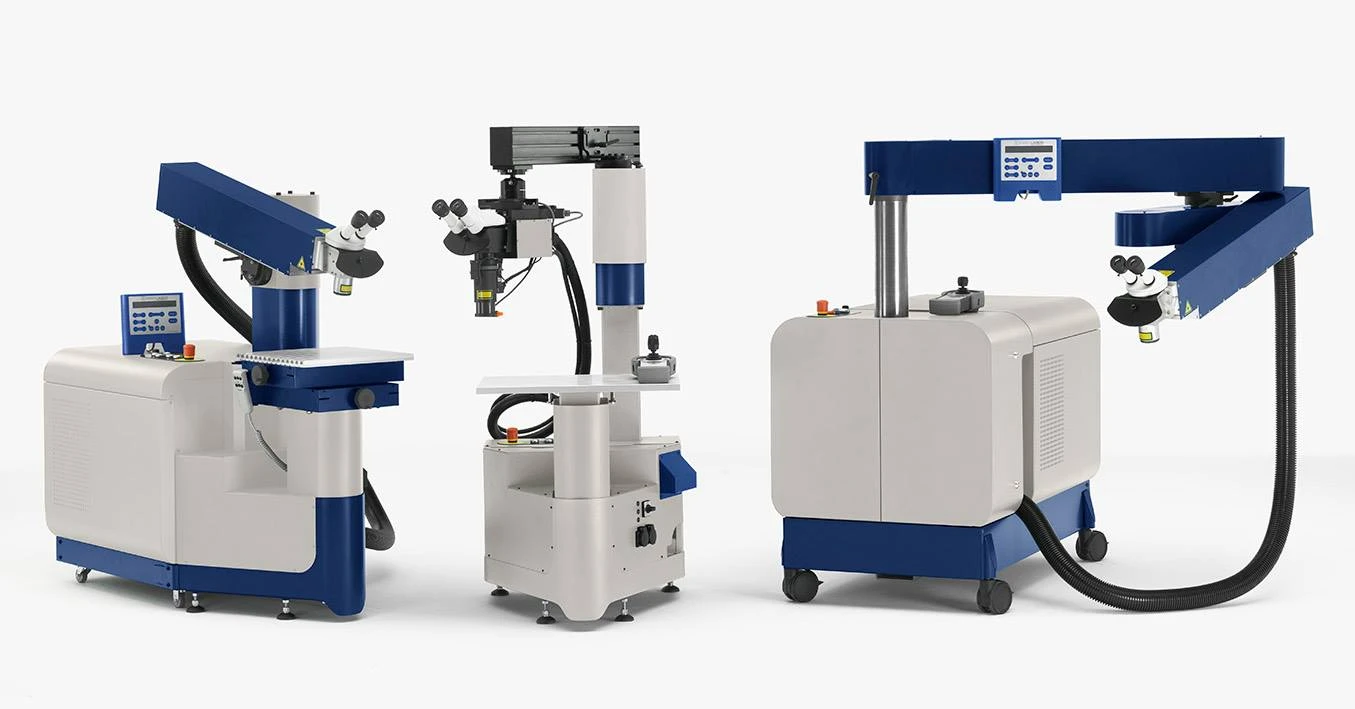
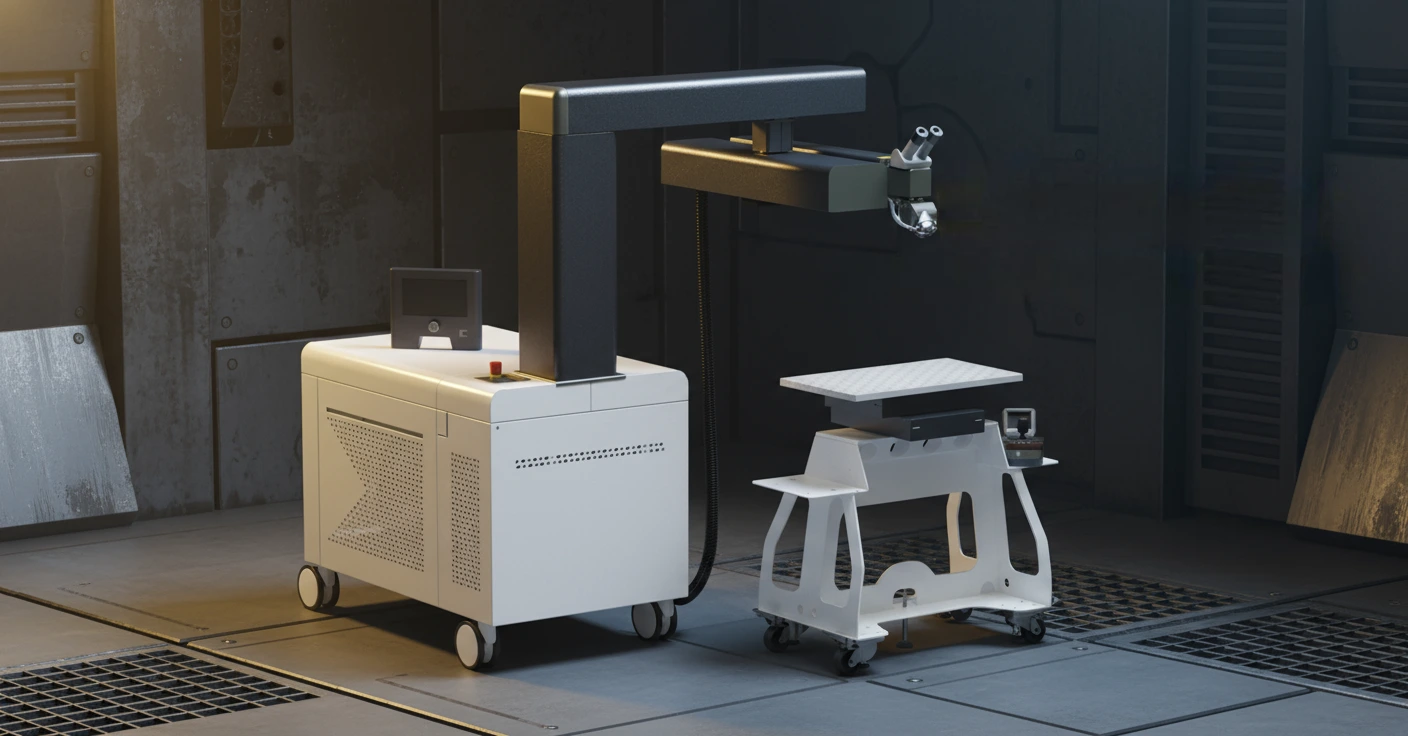
Mobile systems – Sineo Light, Sineo Fibre and Sirius Light – are open, wheeled workstations that come to the part. Maintenance teams roll them to a press, a die cart or a bench; the open frame imposes no workpiece size or weight limit, which removes lifting, trucking and re-rigging from the critical path.
Stationary systems – Sidanus Light, Sidanus Fibre and Siega Fibre – are built for workshops that value repeatability at a fixed station. Toolrooms use them for planned repairs, geometry additions and small-series work under fixtures, with saved programmes supporting predictable, documented outcomes.
When a process needs series automation, the Simass modules extend the concept. The Base Unit, Slide and Rotate modules add flexible motion and part handling for repetitive tasks. Manufacturers configure a cell that fits their sequence: a base platform, a linear slide for controlled travel, a rotary module for circumferential seams. Across all systems, Sigomatic control keeps the interface consistent, easing training and cross-use.
Super Pulse Technology:
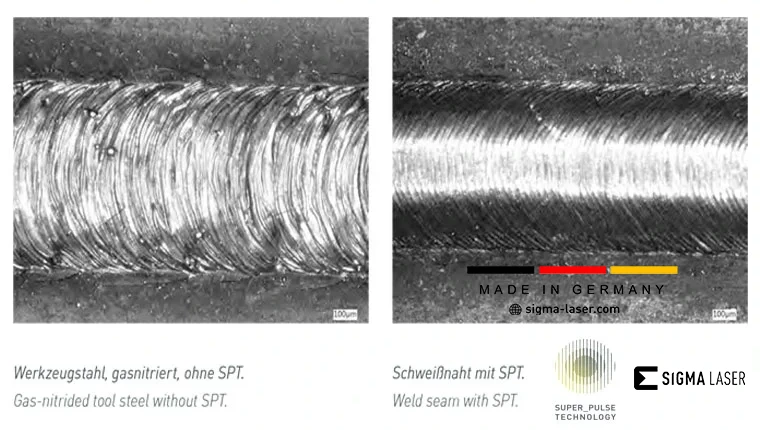
On all six machines, Sigma Laser applies its Super Pulse Technology (SPT), introduced in 2018. The idea is straightforward in business terms: control heat input so seams are even and distortion is low, even on sensitive alloys. SPT shapes and times the pulse to stabilise the melt pool, so the bead forms smoothly and adjacent material stays closer to its original state.
Why does this matter to a plant manager? Less rework: a uniform seam means less polishing and fewer corrective passes, and tolerances hold more often. For quality, difficult joints on tool steel, titanium or nickel-based alloys become far more predictable from job to job and operator to operator.
Control is only useful if it is repeatable. Sigomatic and Sigomatic Pro let teams set, save and recall parameter sets, so a trusted setup moves with the job across tools and shifts, and the repair can be documented against a work order for audits. For aerospace and medical work, that traceability supports internal procedures without adding complexity on the shopfloor.
Industries served
Tool and mould making: Building up worn parting lines, sealing edges and ejector areas, repairing cracks and adding geometry to cores and cavities without disassembling the entire tool.
Medical devices: Adjusting and maintaining validated moulds for implants and instruments, adding material for minor geometry changes and addressing local blemishes while protecting surrounding surfaces.
Aerospace: Repairing and modifying fixtures, thin brackets and titanium housings with localised heat so critical alignments and surface conditions remain stable.
Automotive suppliers: Bringing injection moulds, die-casting tools and stamping dies back into tolerance by adding material exactly where needed, then polishing back to spec to keep presses running.
Electronics: Fine seam and spot welding on housings, connectors and shields where small features and heat-sensitive components demand precise, controlled input.
Jewellery: Localised repairs and adjustments on rings, clasps and settings with minimal heat spill, protecting stones and finishes while restoring function and appearance.
Example from practice:
A European automotive supplier faced a damaged cavity in a multi-impression injection mould after an unplanned event on a night shift. Instead of shipping the tool out and waiting, the team rolled a mobile fibre system to the press area and stabilised the situation on-site. Material was added only where the cavity had chipped. The operator followed a stored parameter set and documented the repair in the control software. Super Pulse Technology kept the heat focused, reducing the finishing work to a local polish. The mould returned to service without a full teardown, and the plant avoided extended downtime and an unnecessary remake.
Design and usability: German Design Award 2025
Ergonomics and clarity shorten the learning curve. Sigma Laser’s Sineo platform was recognised with a German Design Award 2025, underlining the role design plays in daily productivity. Controls, movement and access are laid out so operators can focus on the seam rather than on menus or the frame; new users reach stable results quickly, while experienced welders fine-tune and save procedures for later recall.
Downtime is expensive, so support needs to be fast. Remote diagnosis software lets Sigma Laser’s technicians assess system behaviour without travelling to site, so issues are narrowed down quickly and machines return to operation sooner.
Outlook: automation and international growth
As manufacturers bring more work in-house, demand grows for documented, repeatable and scalable laser welding. The Simass series meets this with flexible modules for series production and semi-automation. The Base Unit provides a stable platform. Slide and Rotate modules add linear and rotary motion to suit recurring jobs and small-batch sequences. Combined with Sigomatic recipes and remote diagnosis, teams can move from ad-hoc repair to a controlled programme with clear records and consistent results.
Internationally, Sigma Laser now serves customers in more than 25 countries. Toolrooms, medical device makers, aerospace and electronics producers apply the same principles: repair instead of replace where sensible, document what matters, and fit the machine to the process. The company’s stated ambition is to keep engineering its systems around the customer’s workflow rather than the other way round.
Alexander Bellouzi, Head of Design & Engineering at Sigma Laser, sums up the approach:
“We design laser welding systems around real jobs on real shopfloors, so customers can repair instead of replace, document what they do and keep production moving.” – Alexander Bellouzi, Head of Design & Engineering, Sigma Laser
Sigma Laser has developed and manufactured industrial laser welding systems in Hanau, Germany, since 2005. The range comprises six five-axis systems – mobile (Sineo Light, Sineo Fibre, Sirius Light) and stationary (Sidanus Light, Sidanus Fibre, Siega Fibre) – with Nd:YAG (1064 nm) or fibre laser sources (1070 nm), complemented by Simass automation modules and Super Pulse Technology. The Sineo system won the German Design Award 2025; customers are located in more than 25 countries.
To evaluate whether mobile or stationary systems fit your workflow, and how to configure automation with Simass, talk to Sigma Laser’s application engineers. They can review your parts, process and documentation needs.
About the company: Sigma Laser GmbH, Hanau, Germany – development and manufacture of industrial laser welding systems since 2005.