
Manufacturers have invested heavily in ERP, warehouse, production, quality, transport and customer management systems. Each platform may perform its own role effectively, yet employees can still lose time moving information from one application to another, waiting for approvals or filling the gaps between systems with spreadsheets and email.
In many cases, the next productivity challenge is no longer inside the individual applications. It sits in the hand-offs between them.
When Good Systems Still Create Inefficient Work
A modern manufacturing business may rely on ERP for orders and inventory, WMS for warehouse execution, MES for production, CRM for customer information and specialist applications for transport, quality or maintenance.
Individually, these systems can provide accurate data and sophisticated functionality. The difficulty appears when a business process crosses several of them.
An employee may receive information in one application, complete part of a task in another and then manually notify someone in a third department. Data may need to be entered again, an approval may depend on an email, or a supervisor may have to check several systems to understand whether work can continue.
The organisation is digital, but the process itself is still fragmented.
This distinction matters because employees do not experience business systems in isolation. They experience complete workflows. If moving from one step to the next requires manual intervention, productivity can suffer even when every individual platform is working as intended.
The Hidden Cost of Handoffs
Many of these inefficiencies are easy to overlook because each one appears small.
Copying a reference number between applications might take less than a minute. Sending an email to confirm that an inspection has been completed may take only a few more. Switching systems to check stock, production status or delivery information may seem like an ordinary part of the job.
Repeated across hundreds of transactions and multiple departments, however, those small hand-offs begin to accumulate.
They can also introduce operational risks. Information may be entered differently in two systems. An approval can remain unnoticed in an inbox. A warehouse employee may be working from information that has not yet been reflected in the ERP. Another team may wait for confirmation that has already been recorded elsewhere.
The result is a form of hidden operational friction that is difficult to identify in a conventional system review. Nothing is necessarily broken. The process is simply requiring more human effort than it should.
Why Integration Alone Does Not Solve the Problem
The obvious response is to integrate the systems, and modern APIs make data exchange far easier than it once was.
But system integration and workflow integration are not the same thing.
Two applications may exchange data successfully while employees still have to decide what happens next. A production event may update the ERP, for example, but an exception could still require someone to identify the right manager, request approval and manually communicate the decision back to operations.
The data moved. The process did not.
A connected workflow also needs to account for people, business rules and exceptions. It should determine who needs to act, what information they need, how the next step is triggered and what should happen when the normal sequence cannot continue.
This is why process orchestration is becoming an important part of enterprise technology strategies. The challenge is not simply getting systems to communicate. It is getting work to move smoothly across them.
From Connected Systems to Connected Workflows
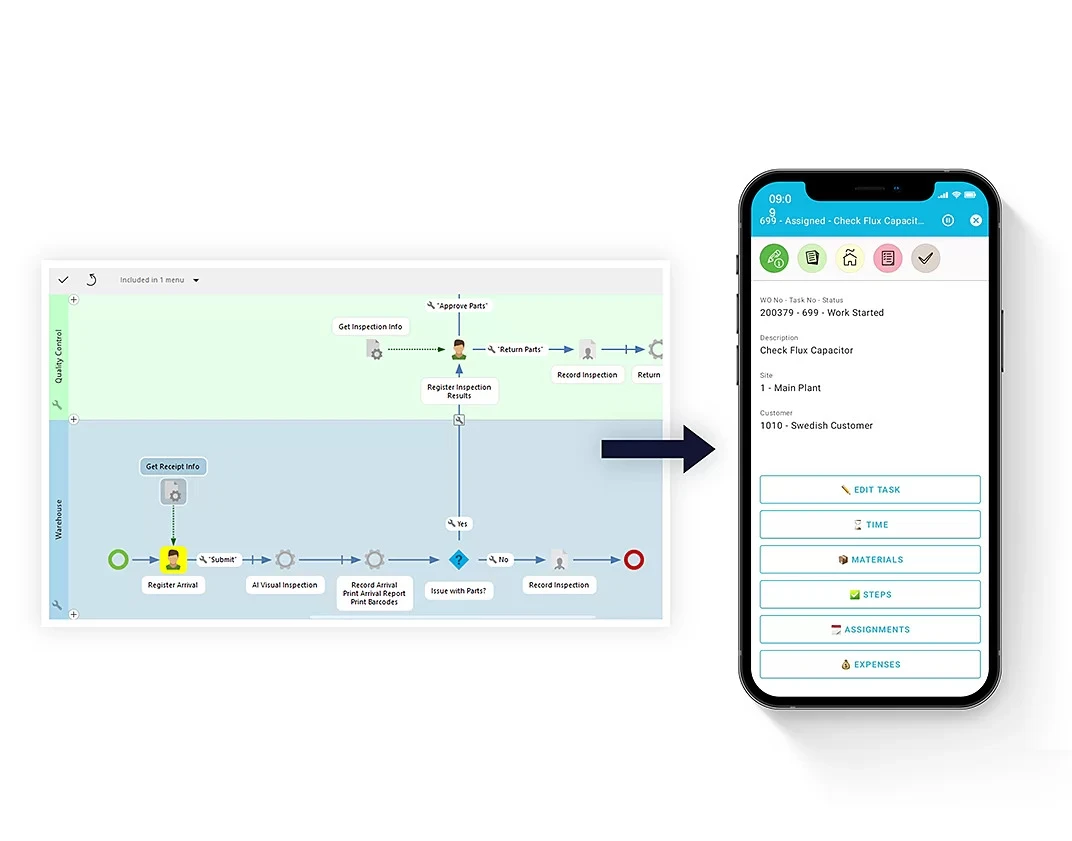 One approach is to keep the core transactional systems stable while adding a flexible workflow layer around them.
The ERP can remain the system of record for orders, inventory, production and other core data. Other specialist systems continue to perform the functions for which they were implemented.
The workflow layer then coordinates the process that crosses those systems.
It can present an employee with the information needed for a particular task, trigger an approval, route an exception, collect input from a mobile device and return the completed transaction to the appropriate business system.
This can also reduce the need for employees to understand where every piece of information is stored. A warehouse operator does not need to know which application owns a particular data field. The operator needs an interface that presents the right information at the right time and makes the next action clear.
That shift from application-centric design to workflow-centric design can be particularly valuable in operational environments, where users often work from scanners, tablets or mobile devices rather than traditional desktop ERP screens.
What This Looks Like in Manufacturing
Manufacturing provides a clear example because digital information is closely connected with physical work.
Consider a production order that requires material from a warehouse. The ERP contains the requirement, but someone still has to locate, pick and confirm the material. Depending on the process, the next stage may involve production reporting, a quality check or an exception that requires approval.
If each stage is handled independently, employees may have to move between applications or communicate manually before work can continue.
A connected workflow can instead use the ERP transaction as the starting point. The warehouse employee receives a guided task on a mobile device. Completion triggers the next step. If an exception occurs, it can be routed automatically to the appropriate person. Once the process is complete, the relevant information is synchronised back to the core system.
The ERP has not been replaced. The surrounding work has simply been made easier to execute.
This same principle can apply to receiving, quality inspections, production reporting, material movements, approvals, shipping and other processes that cross departmental or system boundaries.
How Infor M3 Users Can Approach the Problem
For organisations already using Infor M3 and Factory Track, the challenge may not be adding another transactional system. It may be extending existing transactions into broader business processes that involve additional people, applications or decisions.
Factory Track can manage warehouse and manufacturing transactions, while some operational workflows extend beyond those individual transactions. A quality issue, for example, may require additional information, an approval, communication with another department and interaction with systems outside M3.
Novacura Flow for Factory Track is one example of a layered approach to this problem. It can connect Factory Track transactions with workflow automation, mobile applications and other business systems while leaving the Infor M3 core unchanged.
The platform supports two-way communication with M3 and can connect workflows with systems such as WMS, MES, CRM, TMS, IoT services and other applications. It can also provide role-specific interfaces across mobile devices, scanners and desktop environments.
The broader principle is important: organisations do not necessarily need to redesign the core ERP every time an operational process changes. A separate workflow layer can provide flexibility while preserving the stability of the underlying system.
What a Workflow Layer Should Actually Provide
A useful workflow layer needs to do more than create another user interface.
It should be able to exchange data in both directions with the core business systems so that employees work with current information and completed actions are returned to the correct system of record.
It should also support different working environments. A production manager at a desk, a warehouse employee using a scanner and a technician working from a mobile device may all participate in the same process but require very different interfaces.
Offline capability can also matter where connectivity is unreliable, while configurable business rules help determine how approvals, exceptions and alternative process paths should be handled.
Finally, the workflow layer needs sufficient connectivity to work across the wider application landscape. Manufacturers rarely operate a single isolated system, so the ability to coordinate ERP, warehouse, production, transport and other applications is central to the value of the approach.
The objective is not to create another technology silo. It is to reduce the number of silos employees have to think about.
Productivity Is Increasingly Found Between Systems
Manufacturers will continue investing in ERP, automation, analytics and specialised operational software. Those systems remain fundamental to digital transformation.
But as the technology environment becomes more mature, some of the most valuable productivity opportunities are likely to be found elsewhere.
They are in the manual approval that still depends on email. The warehouse update that has to be entered twice. The production exception that requires several people to check different applications. The employee who has access to all the necessary data but still has to assemble it manually before making a decision.
These are not dramatic technology failures. They are gaps between otherwise capable systems.
Closing those gaps requires businesses to look beyond whether their applications are connected and ask a more demanding question: is the work itself connected?
For manufacturers trying to extract more value from technology they already own, the answer may prove just as important as the next major software investment.