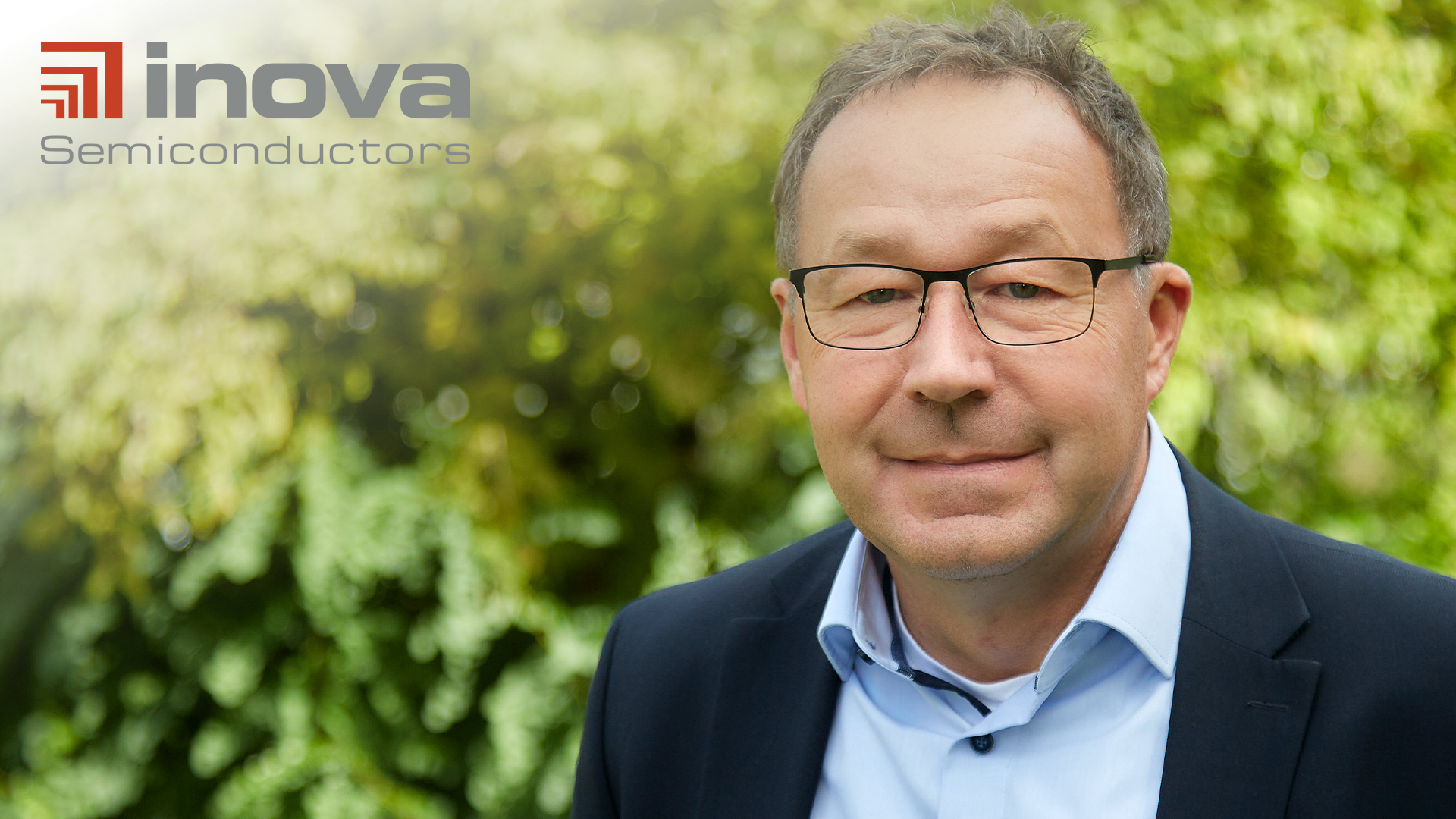
Robert Isele has always been driven by a passion for innovation, having held various technical and leadership roles within the automotive industry across his more than 25-year career. He has been CEO of INOVA Semiconductors GmbH (INOVA) – a fabless semiconductor company based in Munich – since 2023, bringing extensive expertise, empowering his team, promoting transparency, and encouraging creativity. In light of his recognition within the German CEO Excellence Awards 2026, we speak to Robert to learn more about his success.
INOVA Semiconductors GmbH, founded in 1999, is a developer of high-speed serial data communication for the automotive sector, including APIX® (Automotive Pixel Link), the third generation of which has become the de facto standard for SerDes (serializer/deserializer technology) solutions in the industry. INOVA is also renowned for its smart LED (ISELED®) and network connection technology for smart LEDs and sensors (ILAS®) – a comprehensive, industry-leading ecosystem for connecting lights and sensors, supported by more than 60 companies within ISELED Alliance.
Under the name APXpress (Automotive Pixel Express), the company has created a novel high-speed data backbone for zonal architectures and software-defined vehicles (SDVs). This technology supports more than 500 independent data channels at speeds of up to 32 Gbps with very little delay. INOVA now boasts more than 250 million APIX links in the field and has delivered more than 500 million ISELEDs to date.
Robert gives us a deeper insight into these technologies: “A vehicle equipped with partial autonomous driving capabilities may incorporate dozens of sensors dedicated to ADAS (advanced driver assistance system) and safety functions – and hundreds, in case sensors for the powertrain, chassis, comfort systems, and infotainment are included. Consequently, the need for higher data rates, lower latency, and real-time communication becomes critical – particularly for safety-relevant functions such as ADAS and automated driving.
“However, this growing complexity introduces new challenges. More interconnections and interfaces can increase cybersecurity risks, with the infotainment system often cited as a primary attack vector (BSI, 2025). In parallel, today’s wiring harness is one of the heaviest components in a vehicle, contributing not only to higher power consumption but also to increased CO₂ emissions.
“Together, these trends are driving the demand for a new, more suitable, and tailored communication architecture that is high-performance, scalable, and adaptable to the rapidly evolving requirements of next-generation vehicles. The aim of all our solutions is to enable simple plug-and-play solutions for lighting and communication in the car without software, with low energy consumption. With these solutions, we support vehicle architectures for various OEMs and work very closely with the classic Tier 1 world.”
Today, the automotive industry is shaped by major trends including digital cockpits, autonomous driving, over-the-air software updates, interior design, and sustainability. Robert sees first-hand how these trends bring ever-evolving, complex requirements for in-vehicle data communication. As such, INOVA does work closely with OEMs (original equipment manufacturers) and Tier 1 suppliers to co-develop the technologies that make these new functionalities possible. Essential within this process is building long-term relationships that are based on trust, openness, and an aligned vision for innovation.
“We never think in short development cycles,” says Robert. “Every solution we design must be robust, flexible, and future‑proof so that it continues to add value across multiple vehicle generations. This long‑term mindset ensures that our projects run seamlessly from concept to implementation – and that our clients see us as reliable partners, not just technology providers.”
For almost three decades, Robert’s career has been driven by innovation, especially where technology influences how drivers and passengers experience a vehicle. At the beginning of his career in the 1990s, he was developing in-car display systems at a time when navigation and user interfaces were still in their early days. He strongly believed that high-quality displays could only be realised through fully digital interfaces, thus he opted to move away from the analogue video interfaces that were standard then. This led to the initial development of high-speed digital links that were reliable, affordable, and robust enough for automotive use – going on to inspire the creation of today’s APIX technology.
From there, displays evolved from single central units into complex systems like head-up displays and digital clusters. Robert developed this approach to all driver information and rear-seat systems, laying the foundations for the first centralised vehicle architectures as early as 2008. From 2010, vehicle interiors had taken on new significance, not just functionally, but as a key part of the vehicle’s brand identity and emotional design. Traditional materials such as wood and chrome were a thing of the past, replaced by modern surfaces where lighting became central to design and user experience. Robert was head of interior light, paying attention to how light was no longer incorporated as just a static decorative feature but a vibrant communication tool.
It was this insight that led to the development of smart LED technologies, as Robert explains, “To make this work, we had to solve several technical challenges – achieving consistent colour across temperature extremes, enabling fast, reliable networking, and ensuring plug-and-play simplicity. These efforts culminated in 2015 with the introduction of ISELED – the first automotive smart LED – and later ILAS, which together enabled a completely new generation of interior lighting experiences.
“These experiences – from digital displays to connected lighting – shaped my approach as CEO: combining deeper technical understanding with a strong sense of how innovation can define a company’s identity and create long-term value for customers.”
When it comes to his role of CEO and how he approaches leading his team, Robert does so in a way that prioritises open communication, trust, and collaboration. He believes that innovation can only thrive when people feel empowered to share their ideas, use their own initiative, and also learn from their mistakes. He maintains an open-door policy and short decision paths, viewing this as essential toward success by keeping the team agile and ensuring every voice is heard.
“A strong company culture doesn’t come from rules or slogans; it comes from consistent behaviour,” he states. “As leaders, we must live our values every day and demonstrate through our actions what we expect from others. For me, that means promoting transparency, encouraging creativity, and maintaining a constructive error culture where feedback and learning are part of our daily work.
“Continuous communication – across all levels – ensures that everyone in the organisation understands not only our goals but also the “why” behind them. That shared understanding is what aligns us and drives the company forward.”
So, what are the organisation’s goals? Robert tells us that over the past two years, the focus has been on strengthening the organisation and preparing for the next phase of growth, both in terms of technology development and scalability. This year, the business is entering a decisive phase: its product offering is becoming available in significantly higher volumes, and it expects to experience substantial growth across its key markets. At the same time, it is expanding its existing product lines and investing heavily in the next generation of technologies to define the coming decade.
“These efforts will ensure that we not only keep pace with market demands but continue to set new standards in automotive data communication and smart system integration,” says Robert. “This momentum also requires the continued expansion of our organisation – attracting new talent, strengthening our structures, and fostering innovation at every level.”
He concludes, “The goal is clear: to build sustainable, long-term growth powered by technology leadership and strong partnerships.”
CONTACT DETAILS
Company name: INOVA Semiconductors Gmbh
Contact name: Robert Isele
Email: [email protected]
Website: www.inova-semiconductors.de