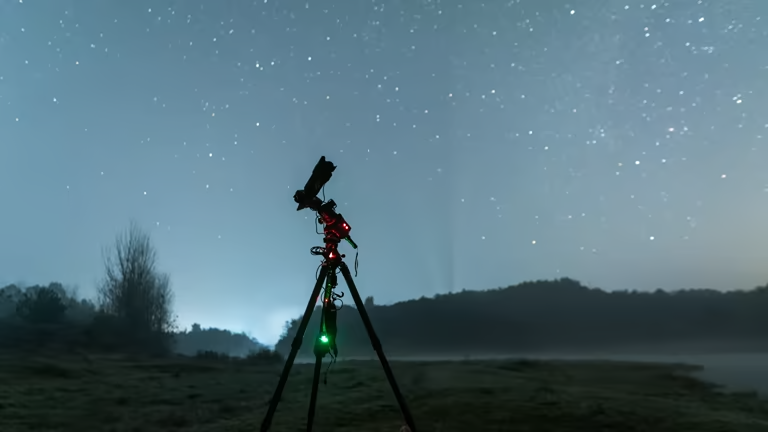

For many aspiring astronomers, the dream of seeing the rings of Saturn or the wispy clouds of the Orion Nebula is often met with a frustrating reality: the night sky is vast, and finding a tiny, dim object in a sea of stars is remarkably difficult.
Traditional “star-hopping”—using a paper map and a finder scope to jump from one star to another—is a romantic skill, but it has a steep learning curve that often leaves beginners staring at empty blackness.
Enter the digital revolution. While computerized “GoTo” telescopes have existed for years, they typically require a complex alignment process that involves leveling the tripod, entering coordinates, and identifying specific alignment stars. For a newcomer, this can feel more like a math exam than a relaxing evening under the stars.
This is where Celestron’s StarSense Explorer technology steps in, transforming the smartphone in your pocket into a sophisticated celestial co-pilot. By leveraging advanced “plate-solving” software, this technology has made celestron telescopes some of the most accessible and user-friendly instruments on the market today.
The Secret Sauce: Plate Solving and LISA
At the heart of this system isn’t a simple compass or GPS. Most apps rely on phone sensors, which can drift and cause errors.
StarSense Explorer uses plate solving, the same method used by observatories. The app captures a real-time image of the sky and compares star patterns against its database using a “Lost in Space Algorithm” (LISA).
Because it reads actual star patterns, it knows exactly where the telescope is pointed. Even if you move or bump the telescope, the app recalibrates instantly.
The Hardware: The StarSense Dock
You might wonder how a smartphone camera, which is usually pointed away from the telescope’s line of sight, can know what the telescope is seeing. The solution is an ingenious piece of hardware called the StarSense Dock.
The dock is a specialized bracket mounted onto the telescope tube. It features an integrated mirror that is precisely aligned with the telescope’s optical axis. When you slide your phone into the dock, the camera looks into the mirror, which reflects the stars directly above.
This setup allows the phone to “see” the same patch of sky as the telescope without requiring you to awkwardly hold the phone up to the eyepiece.
Before your first session, there is a simple 2-minute alignment process where you point the telescope at a distant object (like a streetlight or a bright star) and adjust the app’s crosshairs to match. Once that’s done, the digital and physical worlds are locked together.
The User Experience: “PushTo” Simplicity
Unlike motorized GoTo systems that move the telescope for you, StarSense Explorer is a “PushTo” system. This means you are the motor. When you select an object from the app’s “Tonight’s Best” list—perhaps the Andromeda Galaxy or the planet Mars—the screen displays large, animated arrows.
As you manually push the telescope in the direction of the arrows, the app tracks your movement in real-time. As you get closer to the target, the interface zooms in, providing a more detailed view of the surrounding star field. When the bullseye on the screen turns green, you stop. Look through the eyepiece, and the object will be centered and ready for viewing.
This manual approach has two distinct advantages:
- Speed and Portability: Without motors and heavy battery packs, these telescopes are much lighter and faster to set up.
- Engagement: You still get the tactile satisfaction of moving the telescope yourself, which helps you learn the layout of the sky much faster than a fully automated system would.
A Range of Options
Celestron has integrated this technology across a wide variety of optical designs, ensuring there is a StarSense-enabled model for every type of observer:
- The LT Series: These are lightweight refractor and Newtonian telescopes designed for ultimate portability. They are perfect for families and children who want a “grab-and-go” setup for the backyard or local park.
- The DX Series: Featuring larger apertures and sturdier mounts with slow-motion control knobs, the DX series is aimed at the “serious beginner.” The 130mm Newtonian and 102mm Refractor models offer enough light-gathering power to see impressive detail on planets and brighter deep-sky objects.
- The Dobsonian Series: For those who want the best views of faint galaxies and nebulae, Celestron offers large 8″, 10″, and 12″ Dobsonian models. Combining the massive aperture of a “light bucket” with the precision of StarSense makes these some of the most capable visual telescopes available.
Beyond Navigation: An Educational Journey
The StarSense Explorer app does more than just find objects; it teaches you about them. While you observe, you can read detailed descriptions, view image galleries of what the object looks like through long-exposure photography, and even listen to audio narrations that explain the science and mythology of the stars. It effectively turns your telescope into a personal tour guide of the universe.
Furthermore, the system is designed to work completely offline. You don’t need a cell signal or Wi-Fi to use the plate-solving technology once the app is downloaded. This makes it the perfect companion for trips to “dark sky” sites or remote camping locations where the stars are brightest but the internet is non-existent.
Conclusion
Celestron’s StarSense technology removes the barriers of alignment and navigation, allowing users to focus on discovery. Whether you’re a beginner or exploring a long-held interest, it offers an easy and engaging way to experience the night sky.