







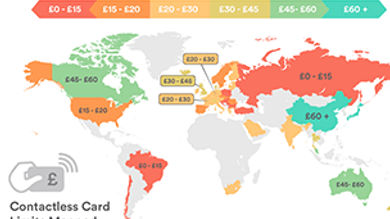
● New map shows contactless card limits in 49 countries across the globe ● Japan and China’s £100+ limit more than three times the UK’s £30 cap ● Poland and Brazil have the smallest contactless allowance of around £10
8th February 2019 · 3 min readThe Biggest Mistakes New Futures Traders Make
Posted on 29th June 2026 · 5 min read
Interest in futures trading continues to grow. In April 2025, global futures trading reached 2.82 billion contracts, representing a 13.5% increase compared to the same month the previous year. More traders are entering the futures markets to trade products such as stock indices, crude oil, gold, and Treasury futures, attracted by the liquidity, leverage, and trading opportunities.
The challenge is that many new traders underestimate how small mistakes can affect their account balance. Poor risk management, emotional decision-making, and inconsistent execution often cause more problems than the market itself.
In this article, you’ll learn the biggest mistakes new futures traders make and the habits that can help improve long-term performance.
Keep on reading to find out more!
Is Futures Trading Risky?
Yes, futures trading carries risk. Futures contracts use leverage, allowing traders to control larger positions with a relatively small amount of capital. While leverage can increase potential profits, it can also magnify losses when the market moves against a position.
However, futures trading is not necessarily riskier than other financial markets. The level of risk often depends on factors such as position size, leverage, risk management, and the trader’s overall experience. Traders who use stop losses, follow a trading plan, and manage risk carefully can reduce many of the risks associated with futures trading.
The table below compares futures trading with several other popular markets:
| Factor | Futures | Forex | Stocks | Crypto |
| Leverage Available | High | High | Low to Moderate | High |
| Market Hours | Nearly 24 hours, 5 days a week | 24 hours, 5 days a week | Exchange hours | 24/7 |
| Volatility | Moderate to High | Moderate | Low to Moderate | Very High |
| Capital Required | Moderate | Low to Moderate | Moderate to High | Low to Moderate |
| Liquidity | Very High in major contracts | Very High in major pairs | Varies by stock | Varies by asset |
| Regulation | Strongly regulated exchanges | Regulated brokers | Regulated exchanges | Varies by jurisdiction |
| Risk of Large Price Swings | Moderate to High | Moderate | Moderate | Very High |
| Common Markets | Indices, commodities, bonds, currencies | Currency pairs | Company shares | Digital assets |
| Suitable for Beginners | With proper education and risk management | With proper education and risk management | Generally beginner-friendly | Often challenging due to volatility |
| Main Risk | Leverage and rapid price movements | Leverage and market events | Company-specific risks | Extreme volatility and market sentiment |
Top 5 Biggest Mistakes New Futures Traders Make
Beginner mistakes have less to do with market knowledge and more to do with risk management and decision-making. That said, here are 5 common mistakes that often hold new futures traders back:
1) Trading Without a Plan
New traders enter positions based on market noise, social media posts, or emotions rather than a structured trading plan. Without predefined entry points, stop losses, profit targets, and risk limits, decisions often become inconsistent.
A trading plan helps remove guesswork and provides a framework for handling different market conditions. Traders who document their rules are often better prepared to maintain discipline when markets become volatile.
2) Risking Too Much on One Trade
One of the fastest ways to damage a trading account is by risking too much capital on a single position. New traders often focus on how much they can make rather than how much they can lose. For example, risking 10% of an account on one trade means only a few consecutive losses could significantly reduce available capital.
3) Overtrading
Futures markets offer opportunities throughout the trading day, but that does not mean every market movement deserves a trade. Most beginners feel pressured to stay active and end up entering low-quality setups simply to remain involved.
Overtrading often increases commissions, creates emotional fatigue, and leads to impulsive decisions. Waiting for setups that meet predefined criteria is usually more effective than constantly searching for action.
4) Chasing Losses
A losing trade can trigger frustration, especially when traders feel they need to recover their money immediately. This often leads to revenge trading, where position sizes increase and risk management rules are ignored. Emotional decision-making can lead to larger losses than the original trade. Accepting losses as part of trading is a key skill that many successful traders develop over time.
5) Using Too Much Leverage
Leverage is one of the main reasons traders are attracted to futures markets. A relatively small amount of capital can control a much larger contract value, increasing both potential profits and potential losses.
For example, a single E-mini S&P 500 futures contract can provide exposure to hundreds of thousands of dollars of market value while requiring only a fraction of that amount as margin.
Without proper risk management, excessive leverage can quickly magnify losses and place unnecessary pressure on decision-making. Understanding contract specifications, margin requirements, and position sizing is essential before increasing exposure.
6 Best Practices for Futures Traders
Successful futures traders often focus on habits and processes. Here are 6 practices that can help improve consistency and risk management over time:
1) Follow a Written Trading Plan
A written trading plan helps remove emotional decision-making and creates a repeatable process for entering and exiting trades. The plan should define entry criteria, stop losses, profit targets, position sizing, and risk limits before a trade is placed.
Documenting these rules allows traders to evaluate performance more objectively and identify areas for improvement.
Common futures trading strategies include:
- Trend following
- Breakout trading
- Pullback trading
- Range trading
- Momentum trading
- Support and resistance trading
2) Use Proper Risk Management
Risk management is one of the most important skills in futures trading. Most professional traders focus on protecting capital first and generating profits second.
A trader can recover from a losing trade, but recovering from a severely damaged account is much more difficult.
Important risk management practices include:
- Using stop-loss orders
- Limiting risk per trade
- Maintaining favorable risk-to-reward ratios
- Avoiding excessive leverage
- Respecting daily loss limits
3) Keep a Trading Journal
A trading journal provides valuable data that can help traders improve decision-making. Recording entries, exits, position size, market conditions, and emotional state creates a record that can be reviewed later. Over time, journals often reveal recurring mistakes, strengths, and behavioral patterns that may not be obvious during live trading.
4) Select the Right Futures Prop Firm
The funding model can have an impact on a trader’s experience. Evaluation requirements, drawdown calculations, payout schedules, consistency rules, platform support, and scaling opportunities vary significantly between providers.
Using a prop firm comparison site such as Prop Firm Compare can help traders compare account features, funding models, trading rules, and payout structures before purchasing an account.
Taking time to evaluate these details may help traders find a program that better aligns with their strategy and risk tolerance.
5) Review Trades Regularly
Trade reviews help identify what is working and what needs improvement. Successful traders review winning and losing trades at the end of each week to evaluate execution, risk management, and adherence to their trading plan.
Performance metrics such as win rate, average risk-to-reward ratio, average holding time, and maximum drawdown can provide useful insight into trading performance.
6) Continue Learning About Futures Markets
Futures markets are influenced by economic data, interest rate decisions, inflation reports, employment numbers, and geopolitical developments. Understanding these factors can help traders make more informed decisions. Following market news, studying contract specifications, learning about market structure, and improving trading psychology can all contribute to long-term development as a futures trader.
Futures Trading Success Starts With Good Habits
Every futures trader makes mistakes at some point. The difference is that successful traders learn from them and make adjustments rather than repeating the same habits. Trading without a plan, risking too much capital, or letting emotions drive decisions can slow progress and create unnecessary setbacks.
Building consistency takes time. Strong risk management, disciplined execution, regular trade reviews, and continuous learning often contribute more to long-term results than finding a perfect strategy.
Futures trading is a skill that develops through practice and experience. Traders who focus on improving their habits and making informed decisions are often better positioned to navigate market challenges and build sustainable performance over time.
Popular Articles
You Might Also Like
Contactless Card Caps Mapped: UK Lags Behind Asia

How to Get Your Business in Touch with the Low Touch Economy
There is still a certain sense that things may never been fully the same as before the world went into lockdown. With social behaviours and etiquette sharply changing, how can businesses built upon years and years of the ‘old’ normal embrace the n...
29th April 2021 · 5 min read
Five Strengths and Five Flaws in the EU’s New Import One-Stop Shop
Beleaguered British retailers are braced for yet more changes to how they sell goods to the EU. From 1 July, a new EU Import One-Stop Shop (IOSS) scheme means British-based e-commerce companies only need to register and pay VAT in one EU country t...
16th June 2021 · 3 min read